
How Are Donated Organs Transported? A Look Inside the Journey From Donor to Recipient
When a person receives an organ transplant, there is an extraordinary amount of coordination taking place behind the scenes. One of the most important parts of the process is getting the donated organ safely from the donor hospital to the transplant hospital—often within only a few hours.
A donated heart, liver, lung, kidney, pancreas, or intestine cannot simply be placed in a box and shipped like an ordinary package. Specialized medical teams, Organ Procurement Organizations (OPOs), transplant centers, couriers, airlines, and transportation coordinators work together to protect the organ and minimize the amount of time it spends without a blood supply.
From Donor to Transplant Hospital
After an organ is recovered from a deceased donor, it is carefully prepared for transportation.
The organ is generally:
- Recovered by a specialized surgical team
- Flushed with a preservation solution
- Carefully examined and packaged
- Placed in a specialized transport container
- Transported by ground or air
- Received by the transplant hospital
- Prepared for transplantation
The exact process varies depending on the organ, the distance involved, transportation options, weather, and the medical circumstances of the recipient.
Keeping the Organ Cold and Protected
For many traditionally transported organs, the goal is to reduce the amount of time the organ is without normal blood circulation. This period is commonly referred to as cold ischemic time.
After recovery, an organ may be flushed with a specialized preservation solution and placed in a sterile container. That container is then protected within an insulated transport system designed to maintain the appropriate temperature.
The organ’s transportation time is carefully documented. The transplant system tracks important logistics, including when an organ leaves the Organ Procurement Organization and when it arrives at the transplant hospital.
The shorter the overall preservation and transportation time can be, the better. Transportation logistics can therefore be an important consideration when determining whether an organ can safely reach a potential recipient.
How Are Organs Transported?
Ground Transportation
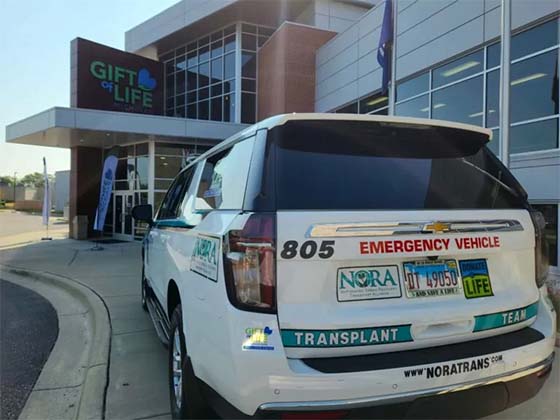
For relatively short distances, organs may be transported by specially arranged ground transportation.
A dedicated vehicle or medical courier can sometimes be the fastest and most practical option, particularly when the donor and transplant hospitals are relatively close to one another.
Ground transportation also avoids some of the delays and scheduling problems associated with airports and commercial flights.
Commercial Airlines
When an organ needs to travel a greater distance, commercial air travel may be used.
Organs can travel between airports in specially prepared containers and are then transferred to ground transportation for the final trip to the transplant hospital.
Kidneys, for example, may be transported by commercial airlines in some circumstances.
Charter and Private Aircraft
Some situations require more flexibility than a regularly scheduled commercial flight can provide.
Chartered or private aircraft may be used when timing is especially important or when commercial flight schedules do not meet the needs of the transplant operation.
Helicopters
Helicopters can also be part of the transportation network, particularly when rapid movement between hospitals or airports is necessary.
The use of helicopters and other aircraft depends on the circumstances, availability, weather, and transportation logistics.
Why Time Matters So Much
An organ does not have unlimited preservation time.
Once an organ has been removed from the donor, the transplant team must work quickly to complete the transportation, recipient preparation, and transplant operation.
This is one reason transportation is considered during organ placement. A potential recipient may be bypassed in certain circumstances when transportation distance, weather, or ischemic time creates a significant logistical problem.
Transportation isn’t simply about distance. A hospital 300 miles away may sometimes be easier to reach than one 150 miles away depending on highways, airports, weather, flight schedules, and other circumstances.
The 11 OPTN Geographic Regions

These regions were originally important to the development of the U.S. organ allocation system. Today, however, regional boundaries should not be thought of as simply meaning that an organ stays within its region. Modern allocation policies have moved toward broader distribution and continuous distribution models for different organs.
Region 1
Connecticut, Maine, Massachusetts, New Hampshire, Rhode Island, and eastern Vermont
Region 2
Delaware, District of Columbia, Maryland, New Jersey, Pennsylvania, West Virginia, and part of northern Virginia
Region 3
Alabama, Arkansas, Florida, Georgia, Louisiana, Mississippi, and Puerto Rico
Region 4
Oklahoma and Texas
Region 5
Arizona, California, Nevada, New Mexico, and Utah
Region 6
Alaska, Hawaii, Idaho, Montana, Oregon, and Washington
Region 7
Illinois, Minnesota, North Dakota, South Dakota, and Wisconsin
Region 8
Colorado, Iowa, Kansas, Missouri, Nebraska, and Wyoming
Region 9
New York and western Vermont
Region 10
Indiana, Michigan, and Ohio
Region 11
Kentucky, North Carolina, South Carolina, Tennessee, and Virginia
Does an Organ Have to Stay Within Its Region?
No.
This is an important point.
The 11 OPTN regions are not simply 11 separate organ-sharing systems. Organ allocation policies have evolved significantly over the years.
Historically, geographic regions played a larger role in determining the sequence in which organs were offered. More recent allocation policies have reduced the role of geographic boundaries, with broader distribution designed to improve access and make better use of donated organs.
An organ can therefore travel across state lines—and potentially across several regions—to reach an appropriate recipient.
Who Coordinates the Journey?
Several organizations and medical professionals can be involved in transporting a donated organ.
Organ Procurement Organizations
An Organ Procurement Organization (OPO) coordinates the recovery of donated organs and works with hospitals and transplant centers.
Transplant Centers
The transplant hospital prepares the recipient and coordinates with the OPO regarding the organ’s arrival and the timing of surgery.
Surgical Recovery Teams
Specialized surgical teams recover organs from the donor and prepare them for transportation.
Transportation Providers
Depending on the circumstances, transportation can involve medical couriers, ground vehicles, commercial airlines, charter aircraft, or other transportation services.
OPTN
The Organ Procurement and Transplantation Network (OPTN) coordinates the national transplant system and maintains information systems used for organ matching and transplantation.
What Happens When the Organ Arrives?
When the organ reaches the transplant hospital, it is received by the transplant team.
The team confirms the organ’s identity and documentation and completes the necessary checks before the organ is taken into the operating room.
Meanwhile, the recipient has already been preparing for surgery.
For a patient waiting for a heart, liver, lung, or another organ, this can mean that everything happens very quickly. The recipient may be called to the hospital, undergo final testing, and prepare for surgery while the donated organ is still in transit.
New Technology Is Changing Organ Transportation
Traditional cold storage is not the only way organs can now be preserved.
Newer technologies, including machine perfusion, can circulate oxygenated or specially prepared fluids through an organ under controlled conditions.
Some systems can keep organs at colder temperatures, while others maintain organs closer to normal body temperature. These technologies may provide transplant teams with additional information about an organ and, in some cases, allow organs to be transported or evaluated in ways that were not previously possible.
The use of organ preservation technology continues to evolve.
A Remarkable Journey
The transportation of a donated organ is one of the most remarkable logistical operations in modern medicine.
From the moment an organ is recovered, teams are working against the clock. The organ may travel by ambulance or specialized vehicle, move through an airport, fly hundreds or even thousands of miles, and then travel by ground vehicle to a transplant hospital.
All of this happens so that a donated organ can reach someone who may have been waiting months or years for a transplant.
Behind every successful transplant is not only a donor and recipient, but also a large network of surgeons, nurses, OPO professionals, transplant coordinators, pilots, couriers, laboratory personnel, hospital staff, and many others.
The gift of donation may begin in one hospital, but its journey can cross states, regions, and hundreds of miles before it gives another person a chance at life.
A Note About the OPTN Regions
The 11 regions described above are administrative regions of the OPTN. They should not be interpreted as fixed boundaries that prevent organs from being transported elsewhere. Current allocation policies increasingly use broader distribution methods, and the importance of geography varies by organ and allocation policy.
This article is intended for educational purposes and is not medical advice. Organ allocation, preservation, and transportation policies can change as the U.S. transplant system evolves.
“`