An excellent video discussing the transplants
The Baby Fae Experiment: A Step Toward Success
In October 1984, Dr. Leonard L. Bailey and his team at Loma Linda University Medical Center in California took a bold step by performing the world’s first xenotransplant (cross-species transplant) on a human infant. The patient, Baby Fae (Stephanie Fae Beauclair), was born with hypoplastic left heart syndrome (HLHS) — a condition that was considered universally fatal at the time (Bailey et al., 1985).
With no available human donor hearts suitable for an infant, Dr. Bailey transplanted a baboon heart into Baby Fae. Initially, the transplant was deemed a surgical success as the heart functioned well in her chest. Sadly, Baby Fae passed away after 21 days due to complications related to organ rejection, primarily because of mismatched blood types (Bailey et al., 1985).
Though the xenotransplant failed to save Baby Fae, the procedure proved that neonatal heart transplantation was technically possible and paved the way for future success with human donor hearts.
The First Successful Human Pediatric Heart Transplant
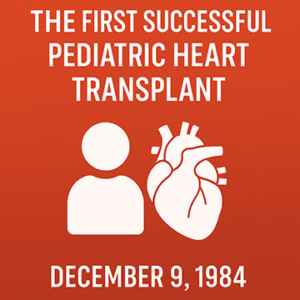
On November 20, 1985, Dr. Bailey and his team again made history by performing the first successful human-to-human heart transplant in a newborn infant — a milestone in the field of pediatric cardiac surgery. The patient, known to the public as “Baby Moses” (real name Eddie Anguiano), was a 4-day-old boy also diagnosed with HLHS.
This time, the donor was another human infant, whose heart was size- and blood type-compatible. The surgery was a success, and Baby Moses survived the transplant — living well into adolescence, a remarkable outcome that demonstrated the viability of heart transplantation in the smallest patients (Bailey, 2001).
Why This Surgery Was So Groundbreaking
Performing a heart transplant on an infant posed multiple, unprecedented challenges:
- Tiny Organs and Vessels: Infant heart vessels measure only millimeters in diameter, demanding extreme surgical precision.
- Immature Immune System: Interestingly, the underdeveloped immune systems of newborns reduce the risk of immediate organ rejection — a factor that contributed to Baby Moses’s survival (Bailey, 2001).
- Donor Heart Shortage: Finding a donor heart of the correct size, age, and blood type remains one of the biggest obstacles to neonatal transplantation even today.
Dr. Bailey’s pioneering work addressed these challenges and created a surgical roadmap for future teams worldwide.
References
- Bailey, L. L., Nehlsen-Cannarella, S. L., Concepcion, W., & Jolley, W. B. (1985). Baboon-to-human cardiac xenotransplantation in a neonate. Journal of the American Medical Association (JAMA), 254(23), 3321–3329. https://doi.org/10.1001/jama.1985.03360230065026
- Bailey, L. L. (2001). The saga of baboon-to-human cardiac xenotransplantation in a newborn: A personal account. The Journal of Heart and Lung Transplantation, 20(6), 552–556. https://doi.org/10.1016/S1053-2498(00)00379-0
- Boucek, M. M., Aurora, P., Edwards, L. B., et al. (2003). Registry of the International Society for Heart and Lung Transplantation: Sixth official pediatric report—2003. The Journal of Heart and Lung Transplantation, 22(6), 636–652. https://doi.org/10.1016/S1053-2498(02)00754-5
Visit the SHOP